
How China Pneumatic Corporation’s Low Vibration Technologies Transformed the Global Pneumatic Tool Industry

How China Pneumatic Corporation’s Low Vibration Technologies Transformed the Global Pneumatic Tool Industry


For decades, reciprocating pneumatic tools—air saws, air files/lappers, and air hammers—were known for their high vibration, loud operation, and operator fatigue. They were essential in automotive repair, aerospace trimming, metal fabrication, construction, and precision manufacturing, yet they imposed ergonomic burdens and safety risks that industries accepted as unavoidable. That changed when China Pneumatic Corporation (CPC) pioneered the world’s first low vibration air saw, followed by its family of low vibration air files/lappers and shock reduced air hammers — technologies now protected by multiple international patents and quietly powering many of the world’s most famous tool brands. CPC did not merely introduce incremental improvements; it fundamentally redefined what pneumatic cutting and chiseling tools could be.


Reinventing the Air Saw: The First Global Breakthrough


Before CPC’s innovation, traditional air saws produced severe reciprocating vibration due to unbalanced motion, rigid housing design, and limited damping technology. These tools caused:


  • Operator fatigue and HAVS-related risk
  • Poor cutting accuracy
  • Limited control over thin metals or composites
  • Reduced productive working time


CPC’s patented low-vibration air saw design introduced:


  • counterbalanced internal mechanisms to cancel reciprocating forces
  • engineered damping structures isolating the motor from the housing
  • Redesigned stroke geometry, reducing lateral vibration
  • ergonomic housings improving grip, control, and smoothness


This was the first commercial solution that fully addressed vibration at its source—not by adding external padding, but through true mechanical innovation.


The result was a step-change in performance:


Operators could cut longer, more precisely, and more safely than ever before.


Low-Vibration Air File & Lapper: Precision and Comfort for Modern Manufacturing


CPC extended its vibration-reduction technology to air files and lappers—tools widely used in:


  • mold & die finishing
  • aerospace component trimming
  • automotive bodywork
  • composite manufacturing
  • metal deburring and polishing


The patented systems dramatically reduced transmitted vibration, enabling:


  • longer working time without fatigue
  • high-precision finishing on sensitive surfaces
  • better consistency across shifts and teams
  • lower long-term ergonomic risk for operators


These improvements opened new use cases—especially in the aerospace and high-precision industries, where vibration had previously limited tool adoption.


Shock-Reduced Air Hammer: A Revolution in Impact Tool Safety


Air hammers were historically notorious for:


  • Intense shock loads
  • Operator discomfort
  • Risk of repetitive-strain injuries
  • Limited controllability in delicate applications


CPC’s patented shock-reduction air hammer changed the category by introducing:


  • Impact-damping structures that absorb recoil
  • Optimized valve and piston geometry for smoother energy transfer
  • Reduced peak shock transmitted through the handle
  • Significantly improved controllability for fine work


The shock reduction not only improved operator safety — it increased productivity, because users could:


  • Maintain consistent chiseling pressure
  • Operate longer without strain
  • Achieve cleaner, more accurate results


This positioned CPC’s design as the benchmark for professional-grade pneumatic impact tools.


Setting New Global Standards for Ergonomics and Safety


CPC’s inventions arrived just as global standards bodies (EU, UK, OSHA, CE machinery directives) began tightening exposure limits for vibration and shock in industrial tools. CPC was one of the first manufacturers whose reciprocating and impact tool families met or exceeded these standards. As a result, many global OEM brands adopted CPC’s patented designs—either as private-label partners or as integrated technology suppliers.


Today, CPC’s technologies are sold under multiple well-known brand names worldwide.


Many companies claim performance leadership, but the core vibration-reduction engineering can be traced back to CPC’s pioneering patents.


How CPC Changed the Industry


1. Ergonomics Became a Strategic Priority


CPC proved that vibration was not an unavoidable byproduct—it was a solvable engineering problem.
After CPC’s success, “low vibration” and “shock reduced” became standard specifications for premium pneumatic tools.


2. Expanded Industrial Applications


Aerospace trimming, carbon fiber cutting, EV battery pack processing, precision mold finishing, and composite fabrication all grew rapidly thanks to the newfound stability and control of CPC’s low-vibration designs.


3. Higher Productivity Through Reduced Fatigue


Operators could work longer and achieve better accuracy, reducing rework and downtime.


4. Triggered Industry-Wide Innovation


Competitors began developing their own vibration-control technologies, stimulating a global shift toward safer, more ergonomic tool engineering.


5. Elevated Pneumatic Tools from Commodity Products to High-Value Solutions


Instead of being seen as consumable tools, air saws and air hammers became precision instruments—supporting premium pricing and professional markets.


Trusted Worldwide as the Quiet Power Behind Leading Brands


While CPC often works behind the scenes through OEM and ODM relationships, its technologies are present in:


  • automotive body shops
  • aerospace production lines
  • shipbuilding yards
  • metal fabrication plants
  • railway manufacturing
  • wind turbine and heavy-industrial maintenance


The world’s leading tool companies rely on CPC’s innovations to offer safer, smoother, and more advanced tools to their customers.


Changing the Industry from the Inside Out


China Pneumatic Corporation’s breakthroughs in low vibration air saws, air files/lappers, and shock reduced air hammers did far more than improve operator comfort. They transformed global expectations for how pneumatic tools should perform—ushering in a new era of safety, precision, and engineering sophistication.


Today, CPC’s patented technologies remain a foundational part of many internationally recognized brands, proving that a single company’s engineering vision can elevate an entire industry.


After more than 25 years, we remain proud of the role we played in introducing these world-first low-vibration and shock-reduced technologies to the global pneumatic tool industry. What began as a bold engineering vision has grown into an innovation adopted worldwide, reshaping safety standards, productivity expectations, and the way professional users experience pneumatic tools. Even today, we continue to stand behind these breakthroughs with the same commitment to craftsmanship, durability, and operator well-being that defined our original designs. Being part of this transformative chapter in industrial tool history remains one of our most outstanding achievements — and a lasting source of pride as we look toward the next generation of innovation.
Ensuring Reliable Fastening with our patented Wireless Rotary Torque Sensor

In precision assembly, every fastening operation must deliver consistent torque to guarantee product safety, performance, and quality. Over time, however, power tools drift out of tolerance due to wear, vibration, or repeated impact. Without routine verification, this drift can compromise joint integrity and increase the risk of product failure. ZIPPTORK’s wireless rotary torque sensor provides a practical, real-time solution for validating tool calibration, measuring dynamic torque, and ensuring repeatable fastening results under actual operating conditions.


Why Dynamic Torque Measurement Matters


Unlike static torque checks, which measure fasteners after installation, dynamic torque measurement evaluates a tool while it is fastening. This approach captures the accurate torque profile under working conditions, including:


  • Operator technique and handling

  • Tool clutch performance

  • Frictional effects from lubricants, coatings, or washers

  • Joint stiffness and material behavior (hard vs. soft joints)


By simulating real-world fastening, ZIPPTORK’s wireless rotary torque sensor reveals whether a tool consistently meets specifications in the field.

How ZIPPTORK’s Wireless Rotary Torque Sensor Works


ZIPPTORK’s system integrates a wireless rotary transducer between the tool and the fastener. The sensor continuously monitors torque and angle throughout the fastening process, transmitting the data in real-time to a paired controller or software interface.

Key functions include:


  • Torque capture in real time – Records the exact torque delivered during fastening, not just at the end of the cycle.

  • Angle measurement – Tracks fastener rotation to validate that clamp force is achieved correctly.

  • Wireless data transmission – Eliminates the need for cables, making the system easier to use in production environments.

  • Shock and vibration resistance – Engineered to withstand the excessive impact of tools like air or cordless impact wrenches.


This setup effectively transforms a standard torque tool into a torque-monitored system, enabling immediate validation without slowing down production.

Conducting Routine Torque Verification with ZIPPTORK


With the wireless rotary torque sensor, a torque audit can be performed quickly and accurately:


  1. Select representative joints from the production line.

  2. Attach the rotary torque sensor between the tool and fastener.

  3. Tighten the fastener under normal conditions, letting the sensor capture dynamic torque and angle data.

  4. Review readings instantly via the paired ZIPPTORK controller or software.

  5. Compare results with specifications to verify calibration and repeatability.


This process can be repeated as part of a daily torque audit or scheduled preventive maintenance, ensuring tools stay within tolerance.

Data Collection and Torque Analysis


ZIPPTORK’s system does more than measure torque—it also provides a platform for data-driven quality control:


  • Record and store torque readings from multiple fastening cycles.

  • Plot torque trends to identify tool wear or operator variability.

  • Apply statistical process control (SPC) methods, such as Cp/Cpk analysis, to confirm process capability.

  • Maintain traceable records for audits and compliance.


By analyzing torque data, manufacturers can accurately predict tool maintenance needs, minimize unplanned downtime, and ensure consistent quality throughout the assembly process.


Best Practices with ZIPPTORK’s Wireless Torque System


  • Audit tools regularly (daily, weekly, or based on cycle counts).

  • Always test under real joint conditions—hard joint simulators alone don’t reflect field performance.

  • Combine torque + angle analysis for a more accurate assessment of clamp load.

  • Train operators to use tools consistently, minimizing variability.

  • Use stored torque data as part of a preventive maintenance program.


ZIPPTORK’s wireless rotary torque sensor simplifies calibration verification, captures real-time torque and angle under dynamic conditions, and provides actionable data for continuous process improvement. By integrating this tool into routine quality control, manufacturers can ensure their fastening processes remain accurate, repeatable, and reliable—reducing risk, avoiding costly rework, and guaranteeing the integrity of every joint.

Turn Any Air Impact Wrench Into a Torque Controlled Tool with ZIPPTORK

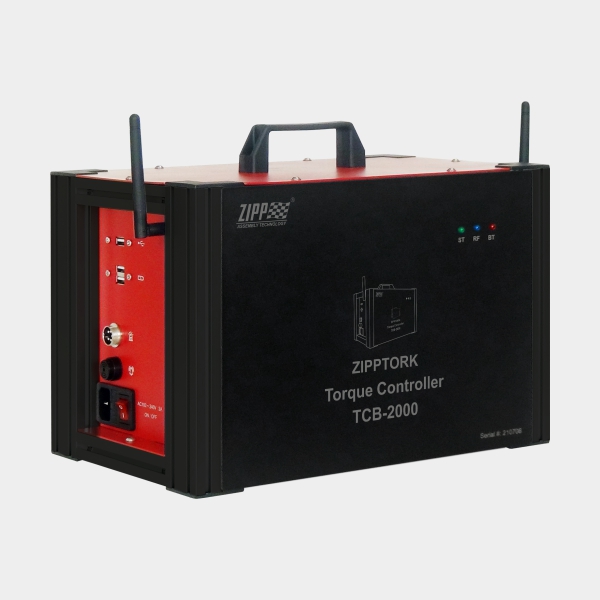
TCB Air Pneumatic Torque tool controller

ZIPPTORK’s torque controller upgrades a standard pneumatic impact wrench into a torque-controlled fastening tool delivering ±10% to ±15% accuracy (joint-dependent). It closes the historical gap between “roughing” with impacts and “controlling” with expensive, high-maintenance pulse or DC tools. Paired with an integrated wireless torque transducer, ZIPPTORK captures every tightening—time, torque curve, angle, and result—so you can monitor, trace, and improve your bolting process without replacing your existing air tools.


Why control torque on an impact wrench?


Traditional impact wrenches are fast and rugged, but they’re open-loop: operators “feel” or “count hits,” which leads to scatter, rework, and weak traceability. Pulse tools improve control, but they also come with higher costs, increased hydraulic maintenance, and more downtime. ZIPPTORK adds closed-loop control and digital traceability to the impact tool you already own.


How ZIPPTORK works


  1. Measure
    A compact wireless torque transducer sits in the load path (socket, inline, or adapter form factor). It streams high-rate torque and angle data during each hit.

  2. Model
    ZIPPTORK’s controller builds an adaptive model of the joint: it distinguishes rundown, snug point, yield tendency, and prevailing torque. It learns the joint rate (hard/soft) and compensates in real time.

  3. Control
    Using the model, the controller manages air flow and impact energy—modulating air to the motor and making a go/no-go decision on additional blows. It stops the tool precisely when the target torque window is reached.

  4. Verify
    The controller validates the achieved torque against the target and tolerance. If the last impact overshoots or undershoots, it flags the cycle and can automatically allow or block a corrective pulse within limits.

  5. Record
    The full torque-time-angle signature is stored and transmitted to your line system (e.g., MES/QMS). Each cycle is traceable by part, VIN/serial, station, operator, tool, and timestamp.


Accuracy: ±10% to ±15%—what it means and how you get it


ZIPPTORK delivers ±10% to ±15% torque accuracy on appropriately selected joints and tools by combining:

  • High-rate sensing of the dynamic torque peak during impact.

  • Joint characterization (hard vs. soft) and adaptive shutoff.

  • Controlled re-hit logic with decaying energy to “sneak up” on the target.

  • Calibration workflow using a reference transducer on a test joint.


Best practices to hit the tighter end (±10%)


  • Use a well-matched impact size for the torque range (avoid oversized tools).

  • Keep air supply stable (regulated pressure, adequate hose ID, minimal drops).

  • Set joint-specific programs (target, window, re-hit count, max time).

  • Validate with a daily check on a master joint or torque analyzer.

  • Maintain sockets/adapters; worn interfaces add scatter.


Note: Extremely soft joints, heavy prevailing torque, or highly elastic stack-ups may trend toward the ±15% end. ZIPPTORK detects these and applies the right control strategy while flagging cycles that exceed capability limits.

Replace pulse tools without their headaches.

AspectOil Pulse WrenchImpact + ZIPPTORK
Capital costHighUse existing impact + controller
MaintenanceHydraulic fluid changes, seals, and downtimeStandard pneumatic upkeep
SpeedFastFast (impact cadence)
AccuracyGenerally good±10%–±15% with adaptive control
Reaction forceLowLow (impacts)
TraceabilityOften optionalStandard: full cycle data
FlexibilityModel-specificWorks with many air impacts

With ZIPPTORK, you retain the speed and durability of impacts while gaining process control and traceability—often at a fraction of the lifecycle cost of pulse systems.


Integrated wireless torque transducer = complete traceability


  • What’s captured per tightening: part ID, program, final torque, angle (if applicable), OK/NOK, peak torque, rundown time, number of blows, re-hit count, operator ID, station ID, timestamp.

  • Live monitoring: dashboards for yield, Cpk, and alarms (e.g., tool drift, unstable joints).

  • Connectivity: edge gateway or direct API to your MES/QMS; local buffering prevents data loss.

  • Analytics: compare torque curves across lots, spot cross-threading, worn fasteners, lubrication changes, or operator technique issues.


Implementation workflow


  1. Application study
    Define torque range, joint type (hard/soft, prevailing torque), cycle time, ergonomics, and quality requirements.

  2. Tool pairing
    Match your current impact wrenches to ZIPPTORK programs; verify sockets/adapters and the wireless transducer form factor.

  3. Baseline & calibration
    Run a capability set on a master joint with a reference analyzer. Create target/tolerance windows and re-hit rules.

  4. Pilot run
    Deploy at one station, log results, and tune shutoff thresholds and air regulation.

  5. Scale-up
    Roll out programs to multiple stations; train operators on visual cues and NOK handling.

  6. Sustain
    Daily check on a master joint, weekly air line audit, and monthly program review using collected data.


Where ZIPPTORK shines


  • Automotive & off-road assembly: chassis, suspension, subframe, and service joints where speed matters but traceability is now required.

  • White goods & general industry: sheet-metal fasteners, frame assemblies, large fixtures.

  • Field service & repair cells: portability with data capture for regulated or warranty-critical work.


Safety, ergonomics, and quality


  • Low reaction torque: impacts transmit little steady reaction, reducing operator strain versus stall tools.

  • Fewer re-hits: precise shutoff lowers vibration exposure and noise compared to “free-running” impacts.

  • Poka-yoke: program-based interlocks (wrong program, missing data, out-of-window torque) prevent pass-through of bad assemblies.

  • Clear OK/NOK feedback: bright indicators and audible signals shorten decision time.


Limitations & how ZIPPTORK addresses them


  • Very soft or springy joints can degrade accuracy; consider using a multi-stage rundown with controlled re-hits or revisiting joint design.

  • High prevailing torque (locking nuts, inserts): set angle-over-torque criteria and monitor the curve shape to avoid misreads.

  • Tool health drift: caught by trend alarms and daily checks; swap sockets and verify balance.

  • RF-noisy environments: buffered logging prevents data loss; verify coverage during commissioning.


ROI snapshot


  • Lower capital costs by reusing existing impacts.

  • Less maintenance than hydraulic pulse systems.

  • Scrap/rework reductions from controlled, traceable torque.

  • Audit-ready records for customers and regulators.

  • Faster changeovers with saved joint programs.


Getting the most from ZIPPTORK


  • Stable, regulated air supply and correct hose ID

  • Correct impact size for torque target

  • Fresh, accurate calibration on a master joint

  • Joint-specific programs (targets, windows, re-hit policy)

  • Operator training on OK/NOK, retorque rules

  • Daily verification & periodic capability review


ZIPPTORK turns the impact wrench you already trust into an innovative, torque-controlled, data-logging solution. Expect ±10–15% accuracy, full traceability, and lower lifecycle costs compared with oil pulse tools—without sacrificing speed or durability. If you need modern process control and proof of compliance, ZIPPTORK is the most direct path to get there.

This site uses cookies to offer you a better browsing experience. By browsing this website, you agree to our use of cookies.