Professional Fastening Solutions with New Dual-Flex Angle Air Impact Wrenches: ZIW340FA and ZIW410FA

Advanced Right-Angle Pneumatic Tools Designed for Tight Spaces, Industrial Flexibility, and High-Efficiency Fastening


CHINA PNEUMATIC CORPORATION (CPC) has introduced two new products to its professional pneumatic fastening lineup: the ZIW340FA 3/8” Drive Dual-flex Angle Air Impact Wrench and the ZIW410FA 1/2” Drive Dual-flex Angle Pneumatic Impact Wrench. Built for applications where traditional straight-body impact wrenches are hard to use, these tools combine compact right-angle access with dual-flex movement and industrial torque power.


The launch addresses the rising demand in automotive service, production assembly, heavy equipment maintenance, and industrial repair sectors, where technicians increasingly require tools that provide torque in tight spaces without compromising durability or control.


Designed for Restricted Access Applications


In many fastening situations, limited space around fasteners is one of the most common challenges for maintenance personnel and assembly workers. Standard impact wrenches often need extra extensions, adapters, or manual adjustments, which increase operating time and reduce efficiency.


CHINA PNEUMATIC CORPORATION (CPC)’s new dual-flex angle series solves this issue by combining an angle-head design with improved articulation, enabling users to access bolts and nuts in hard-to-reach or obstructed spots.


This design is especially useful in:


  • Engine compartments
  • Suspension systems
  • Transmission assemblies
  • Machinery interior maintenance
  • Structural frame assembly
  • Industrial equipment service zones with restricted hand clearance


The company explains that the goal was to offer not only angled access but also flexibility that adjusts to real workshop conditions, where working angles often change.


Dual-Flex Mechanism Improves Operator Freedom


The key feature of both models is the Dual-flex angle head design, which provides better maneuverability during fastening tasks.


Unlike fixed-right-angle impact tools, dual-flex construction lets operators adjust their working positions more naturally, reducing awkward wrist postures and improving access around nearby components.


This flexibility is especially useful during repetitive maintenance tasks, where technicians need to switch among multiple fastening points in different orientations.


According to CHINA PNEUMATIC CORPORATION (CPC) engineers, operator ergonomics was a major development priority:


“The objective was not only to access hard-to-reach fasteners, but also to reduce unnecessary movement and fatigue during continuous industrial use.”


ZIW340FA: Compact 3/8″ Drive Solution for Precision and Accessibility


The ZIW340FA 3/8” Drive Dual-Flex Angle Air Impact Wrench is built for medium-duty fastening tasks that need a compact size and easy access.


Its 3/8″ drive configuration makes it particularly suitable for:


  • Automotive repair
  • Motorcycle maintenance
  • HVAC assembly
  • Appliance manufacturing
  • Precision mechanical service


The compact head design enables access in tight spaces where larger drive tools might be impractical.


Key advantages include:


  • Compact right-angle body for confined areas
  • Lightweight construction for extended use
  • Stable torque delivery
  • Smooth trigger response for better fastening control
  • Durable internal impact mechanism for long service life


The ZIW340FA is particularly useful for service technicians who require both reach and speed without constantly switching between manual and powered tools.


ZIW410FA: 1/2″ Drive Torque for Heavier Fastening Work


For larger fasteners and more demanding industrial applications, the ZIW410FA 1/2″ Drive Dual-flex Angle Pneumatic Impact Wrench provides increased torque capacity while maintaining the same flexible access benefits.


This model targets heavier-duty environments such as:


  • Commercial vehicle maintenance
  • Industrial machinery installation
  • Construction equipment service
  • Steel structure assembly
  • Production line fastening requires larger fasteners


The 1/2” drive platform offers compatibility with common industrial sockets while providing improved fastening and loosening strength.


Its dual-flex design enables users to deliver pneumatic impact force in areas that typically need manual ratchets or long extensions.


Pneumatic Reliability Remains Essential in Industrial Use


While cordless tools are gaining popularity, pneumatic impact tools remain preferred in many professional settings for their reliable power, lighter weight, and continuous operation.


For fixed workstations and industrial maintenance areas with compressed air systems, pneumatic tools still provide several benefits.


  • No battery charging downtime
  • Stable torque delivery throughout operation
  • Lower long-term consumable cost
  • Reduced tool weight compared with battery-powered equivalents


CHINA PNEUMATIC CORPORATION (CPC) notes that angle pneumatic tools remain especially valuable because adding battery systems to compact angle tools often increases bulk and reduces accessibility.


Built for Durability in Harsh Workshop Conditions


Both models are built for long-term industrial use, with internal impact structures designed to endure repeated high-load fastening cycles.

Durability features include:


  • Reinforced internal transmission components
  • Industrial-grade bearings
  • Impact-resistant housing design
  • Reliable forward/reverse switching system


Because angle-head tools often face side-load stress during actual use, structural reliability was emphasized throughout product development.


The company also improved airflow pathways to ensure efficient operation while keeping tool dimensions compact.


Supporting Faster Maintenance Cycles


In industrial maintenance, minimizing access time often directly boosts service efficiency. Technicians often spend more time positioning tools than performing actual fastening. Tools that can reach difficult spots quickly can therefore significantly shorten maintenance cycles. The new dual-flex series aims to reduce:


  • Tool repositioning frequency
  • Socket extension requirements
  • Hand-tool fallback situations
  • Operator fatigue during repeated angle fastening


This is especially important in fleet maintenance, recovery from production downtime, and field service operations where speed impacts operational costs.


Expanding CHINA PNEUMATIC CORPORATION (CPC)’s Professional Pneumatic Portfolio


The release of the ZIW340FA and ZIW410FA demonstrates CHINA PNEUMATIC CORPORATION (CPC)’s broader plan to grow specialized pneumatic solutions beyond traditional impact wrench categories.


The company continues to develop tools focused on real-world industrial use cases rather than just laboratory torque numbers.


This product direction aligns with the broader market demand for tools that enhance accessibility, ergonomics, and real-world fastening productivity.


Availability


The ZIW340FA 3/8” Drive Dual-Flex Angle Air Impact Wrench and ZIW410FA 1/2” Drive Dual-Flex Angle Pneumatic Impact Wrench are now available through the OEM supply network.


Both models are designed for professional users who need dependable pneumatic fastening solutions in restricted-access industrial environments.

Next-Generation Composite Air Impact Wrenches: ZIW1020C and ZIW1010C MINI

Lightweight Design Meets Industrial Power for Modern Assembly Applications


ZIW1010C_ZIW1020C_Twin Turbo Air Impact Wrench

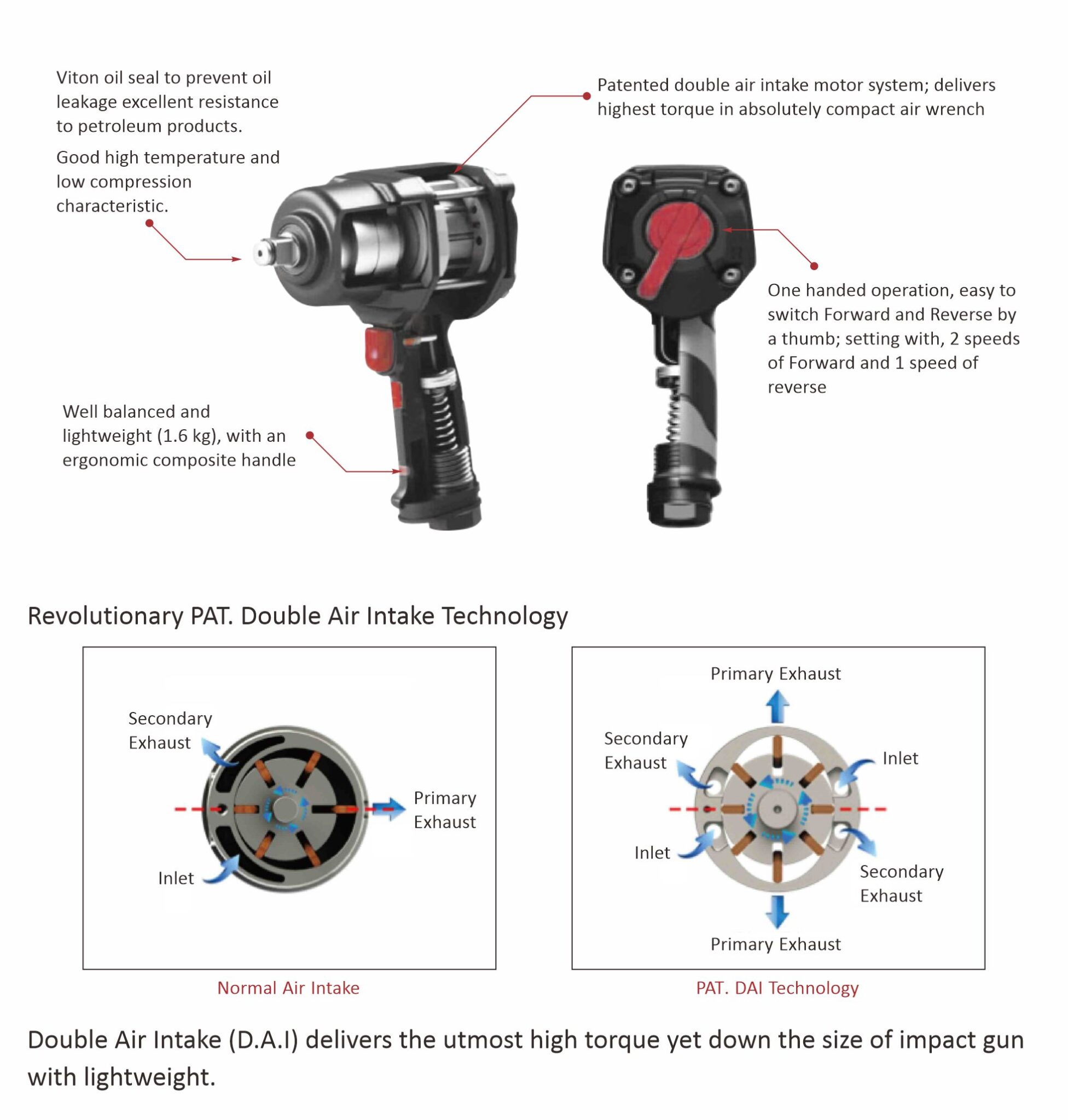
We have launched two new pneumatic impact wrenches designed to meet the evolving needs of modern industrial users: the ZIW1020C 1/2″ Composite Air Impact Wrench and the ZIW1010C 1/2″ MINI Composite Air Impact Wrench. These new models combine lightweight composite construction, ergonomic handling, and high torque performance, providing operators with improved productivity and reduced fatigue during extended use.


As industries continue to balance productivity, operator safety, and cost efficiency, our latest updates aim to offer a practical upgrade path for workshops, assembly lines, automotive service facilities, and industrial maintenance settings.


Addressing Today’s Industrial Challenges


Compressed air tools remain essential in manufacturing and maintenance because of their durability, continuous operation, and lower total ownership costs compared to battery-powered options in high-duty environments.


However, traditional metal-bodied impact wrenches often face challenges like heavy weight, vibration transfer, and operator fatigue — especially during repetitive assembly tasks.


The ZIW1020C and ZIW1010C were designed specifically to solve these problems.


By utilizing advanced composite housing technology, our engineers achieved a significant weight reduction while preserving structural strength and resistance to harsh workshop conditions.


ZIW1020C: Power and Control for Demanding Applications


The ZIW1020C 1/2″ Composite Air Impact Wrench is a versatile tool ideal for automotive repair, heavy equipment maintenance, assembly lines, and general industrial fastening tasks.


Key highlights include:


  • High torque output for stubborn fasteners and industrial assemblies

  • Durable twin-hammer impact mechanism for consistent performance

  • Lightweight composite body reduces operator fatigue

  • Ergonomic grip design improves handling stability

  • Forward/reverse control with adjustable power settings


The composite housing not only reduces weight but also helps prevent the transfer of cold air, enhancing operator comfort in continuous-use settings.


The tool’s balanced torque delivery helps users stay in control while fastening and removing, which is key to preventing over-tightening or damaging fasteners.


ZIW1010C MINI: Compact Size, Professional Performance


Complementing the full-size model, the ZIW1010C 1/2″ MINI Composite Air Impact Wrench is designed for applications where accessibility and maneuverability are essential.


Despite its small size, the MINI version provides impressive torque performance for its size, making it ideal for:


  • Tight engine compartments

  • Confined assembly spaces

  • Maintenance operations requiring mobility

  • Overhead or extended-use applications


The shorter body length allows operation in tight spaces where standard impact wrenches struggle to reach, enhancing efficiency and reducing the need for extra extensions or specialized tools.


Its lighter weight also makes it especially ideal for technicians performing repetitive fastening tasks throughout the day.


Composite Construction: More Than Weight Reduction


While lightweight design is a clear advantage, we highlight that composite construction offers several operational benefits.


  • Vibration damping to reduce operator strain

  • Thermal insulation from cold compressed air exhaust

  • Impact resistance for workshop durability

  • Corrosion resistance compared to traditional metal housings


These features enhance long-term usability and operator comfort — factors increasingly valued by industrial employers seeking to improve workplace ergonomics and safety.


Designed for Real-World Efficiency


Both new models are designed with practical usability in mind. Features such as intuitive controls, balanced weight distribution, and optimized air consumption make it easy for users to incorporate the tools into existing pneumatic systems without needing additional infrastructure investment.


Unlike battery-powered tools that need charging and maintenance, pneumatic impact wrenches offer continuous operation, making them ideal for high-volume settings.


Many industries are now adopting a hybrid approach — blending cordless mobility with pneumatic reliability for fixed workstations — where tools like the ZIW1020C and ZIW1010C are essential.


Supporting Productivity and Sustainability


Reducing operator fatigue directly boosts productivity and improves workplace safety. Lighter tools help minimize repetitive strain risks while ensuring consistent fastening performance across shifts.


Additionally, pneumatic tools usually have a longer service life and easier maintenance than electronic alternatives, promoting sustainability by reducing the frequency of equipment replacement.


We also emphasized serviceability, making sure internal components are designed for easy maintenance and long-term reliability.


Expanding the Professional Lineup


The launch of the ZIW1020C and ZIW1010C expands our growing line of professional air tools and smart fastening solutions. The company continues to develop products that reflect current industrial trends, including torque monitoring, process traceability, and Industry 4.0 integration.


These new impact wrenches act as essential tools that can be combined with advanced torque-control and monitoring technologies, helping customers move toward smarter assembly processes.


Availability


The ZIW1020C 1/2″ Composite Air Impact Wrench and ZIW1010C 1/2″ MINI Composite Air Impact Wrench are now available.


Both models are built for professional users looking for dependable pneumatic performance with contemporary ergonomic design.

Introducing Cutting-Edge Rivet Squeezer Series

Rivet Squeezer
Rivet Squeezer
Rivet Squeezer
Rivet Squeezer


Precision. Power. Durability.


CPC proudly announces the launch of its new Rivet Squeezer family, engineered to meet the rigorous demands of modern manufacturing, aerospace, automotive, and heavy-industry assembly lines. Designed for operators who demand reliable performance, ergonomic operation, and exceptional joint quality, the new lineup delivers superior results across a wide range of rivet installation applications.


From compact handheld units to industrial-grade systems, CPC’s rivet squeezers set a new standard in fastening technology.


Reinventing Rivet Joining with Innovative Design


Riveted joints remain a cornerstone of structural assembly where strength, consistency, and fatigue resistance matter. CPC’s new rivet squeezers combine advanced mechanical engineering with operator-centric design, ensuring every rivet is seated precisely and securely without damaging sensitive materials or compromising joint integrity.


Key benefits of the new series include:


  • High-precision squeezing force for consistent rivet compression

  • Robust construction for durability in demanding environments

  • Ergonomic design for operator comfort and productivity

  • Low maintenance and long service life

  • Alligator Yoke Riveters: Compact Strength

  • Engineered for Accessibility and Control


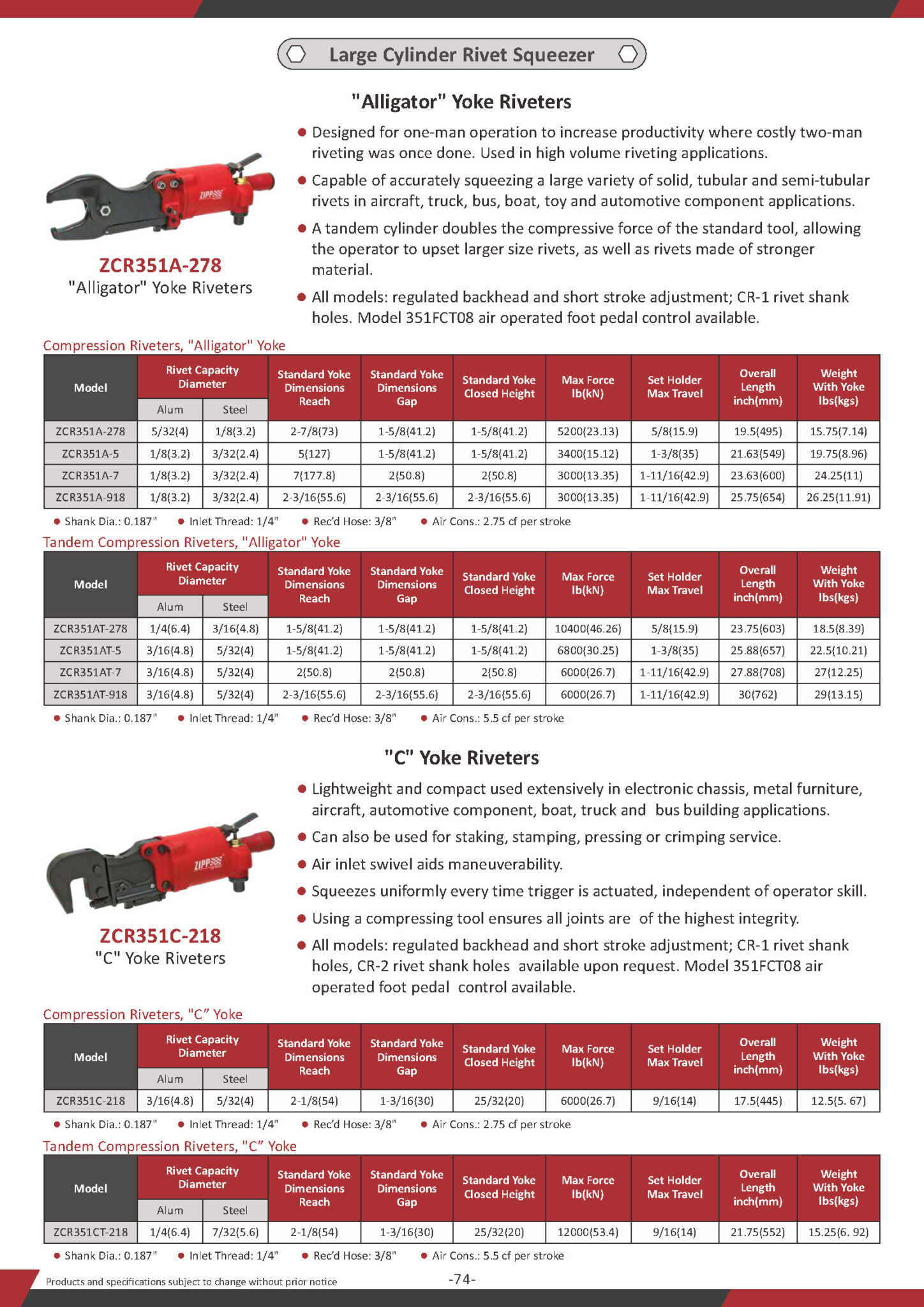
The Alligator Yoke Riveter is a compact yet powerful tool ideal for spaces where traditional squeezers struggle to reach. Its distinctive yoke shape — resembling an alligator jaw — offers a wide throat opening and exceptional visibility, making it perfect for confined or awkward installation areas.


Advantages of Alligator Yoke Riveters:


  • Slim profile for access in narrow or restricted spaces

  • Consistent squeeze force across the full jaw range

  • Lightweight yet rugged construction for operator comfort

  • Quick-change jaws for adaptability to different rivet sizes

  • Suitable for aerospace, metal fabrication, and on-site field repairs


Whether installing blind rivets in aircraft skins or structural panels on equipment frames, the Alligator Yoke Riveter delivers reliable, repeatable performance.


C-Yoke Riveters: Industrial-Grade Precision

Balances Power, Stability, and Ease of Use


For heavy-duty riveting tasks, CPC introduces the C-Yoke Riveter — a robust solution optimized for high-volume production and precision assembly. Its rigid C-shaped frame provides exceptional support and force distribution, ensuring each rivet is compressed accurately and repeatably.


Why Choose a C-Yoke Riveter:


  • Superior structural rigidity for demanding applications

  • High squeezing capacity for larger rivets and tougher materials

  • Stable work-holding for consistent joint quality

  • Ideal for automotive body assembly, heavy framing, and industrial fabrication


The C-Yoke Riveter is designed to integrate smoothly into both manual and semi-automated production environments, offering flexibility for floor-mounted stations, fixtures, and workbenches.


Applications Across Industries


CPC’s Rivet Squeezer lineup serves diverse industrial needs:


  • Aerospace assembly and structural riveting

  • Automotive platforms and body panel joining

  • Shipbuilding and offshore structural work

  • Rail transport components

  • Industrial fabrication and maintenance work


By delivering consistent compression and precise rivet deformation, these tools improve joint strength, fatigue resistance, and overall product quality.


Ergonomics and Operator-Focused Engineering


Beyond raw performance, CPC prioritizes operator well-being and productivity. Every rivet squeezer is designed with features such as:


  • Balanced weight distribution and cushioned handles

  • Low-vibration operation

  • Intuitive trigger and control layout

  • Simple maintenance and parts replacement


These enhancements reduce operator fatigue, increase throughput, and lower long-term operational costs.


Supporting Modern Manufacturing


CPC also offers a full range of optional accessories and service support, including:


  • Multiple jaw sets for different rivet sizes

  • Adjustable stops and spacers

  • Work-holding fixtures

  • Preventive maintenance packages


With global distribution and after-sales support, CPC ensures that every rivet squeezer performs reliably throughout its lifecycle.


A New Era in Rivet Installation


Whether you’re working in precision aerospace assembly or heavy industrial fabrication, CPC’s new Rivet Squeezer lineup — featuring the versatile Alligator Yoke Riveter and the heavy-duty C-Yoke Riveter — offers unmatched performance, durability, and ease of use. They deliver consistent joint quality, exceptional accessibility, and operational efficiency that modern industries require.


Experience the next generation of riveting technology with CPC — where precision meets power.

U.S. lowers tariff on Taiwanese goods to 15% in trade deal

The United States has agreed to lower tariffs on Taiwanese goods from 20 percent to 15 percent, without stacking them on existing most-favored-nation (MFN) rates, Taiwan’s Executive Yuan announced Friday. The deal, reached in trade negotiations that wrapped up Thursday (U.S. time), also provides semiconductors and related products with the most favorable treatment under Section 232 of the Trade Expansion Act, the Cabinet said.


It includes commitments to expand supply chain investment cooperation and deepen Taiwan-U.S. strategic partnership on artificial intelligence, according to the statement. The new 15 percent tariff aligns with U.S. rates on goods from major trade partners such as Japan, South Korea, and the European Union. With this agreement, Taiwan becomes the first country in the world to secure the most favorable treatment for its semiconductor and related product suppliers, which should greatly reduce uncertainties for the local semiconductor industry, the Cabinet said. Beyond the tech sector, lowering the import duty on Taiwanese goods to 15 percent without stacking it on existing MFN rates should help make Taiwan’s non-tech industries more competitive, as they will now be on equal footing with Japan, South Korea, and the EU, the Cabinet added.


Taiwan has also secured the most favorable treatment for other items such as auto parts, wooden furniture, and aircraft components under Section 232. Additionally, Taipei and Washington have agreed to establish a Section 232 negotiation mechanism.

Merry Christmas & Happy New Year from China Pneuamtic Corporation

Merry Christmas & Happy New Year from China Pneumatic Corporation


Merry Christmas And Happy New Year Gif 1 min


Dear Valued Customer,


As the year comes to a close, we would like to extend our sincere thanks for your continued trust and support of China Pneumatic Corporation.


We wish you a joyful Christmas filled with peace and happiness, and a prosperous New Year filled with success, good health, and new opportunities. It has been a pleasure working with you, and we truly appreciate our partnership.


We look forward to strengthening our cooperation and achieving even greater success together in the coming year.


Warmest wishes,


China Pneumatic Corporation

How to Improve Torque Control with In-Process Monitoring

Enabled by Wireless Rotary Torque Transducers


Modern assembly processes generate vast amounts of fastening data in real time. When captured and analyzed correctly, this data provides manufacturers with powerful insights to make more intelligent process decisions, reduce quality failures, and maximize productivity.


In critical bolted joints, relying solely on post-process inspection is no longer sufficient. Today’s manufacturers require in-process monitoring—the ability to evaluate fastening quality as the operation is performed continuously.


What Is In-Process Torque Monitoring?


A smart torque control system equipped with a torque transducer continuously measures applied torque throughout the fastening cycle and feeds this data back into the control system. In-process monitoring refers to the real-time assessment of fastening parameters—such as torque, angle, speed, and time—to verify joint quality during assembly rather than after completion.


By monitoring these parameters in real time, manufacturers can:


  • Detect fastening abnormalities immediately
  • Prevent defective assemblies from moving downstream
  • Reduce scrap and rework rates
  • Improve process consistency and repeatability
  • Minimize variability and quality risk


With in-process monitoring, every fastening operation becomes a verified process. Any deviation from predefined limits can trigger instant feedback, alarms, or corrective actions, ensuring issues are addressed before they escalate into costly failures.


The Role of Wireless Rotary Torque Transducers


Our wireless rotary torque transducers are designed specifically to enable reliable in-process torque monitoring on dynamic power tools, including impact wrenches, pulse tools, torque multipliers, and other rotary fastening equipment.


Unlike traditional inline or reaction-based sensors, our wireless rotary torque transducers are mounted directly in the torque transmission path and rotate with the tool output. This design allows torque to be measured at the point of application, providing accurate, real-time data even under high vibration and impact conditions.


Key advantages of wireless rotary torque transducers include:


  • Accurate real-time torque measurement during the fastening process
  • Wireless data transmission, eliminating cables and slip rings
  • High resistance to shock and vibration, ideal for impact tools
  • Compact and tool-agnostic design, easily integrated into existing tools
  • Seamless connection to torque controllers, PLCs, and IIoT systems


By transforming conventional torque tools into data-enabled smart tools, manufacturers can upgrade their fastening processes without replacing entire tool fleets.


Improving Torque Control Through Real-Time Feedback


When integrated with a torque controller or production monitoring system, the wireless rotary torque transducer provides continuous feedback throughout the fastening cycle. This enables:


  • Real-time verification that the target torque is achieved
  • Immediate detection of joint issues such as cross-threading, stripped threads, or inconsistent clamp load behavior
  • Automatic tool shut-off or process alerts when abnormal torque signatures are detected
  • Closed-loop torque control for improved accuracy and repeatability


The deeper the visibility into the fastening process, the greater the ability to correct problems instantly and make continuous improvements. Instead of reacting to failures discovered later, manufacturers can prevent defects at the source.


Turning Fastening Data into Process Intelligence


Beyond immediate quality control, the data collected by wireless torque sensing solutions creates long-term value. By analyzing fastening data across shifts, tools, and production lines, manufacturers gain insights into:


  • Process capability and stability
  • Tool performance and maintenance needs
  • Joint behavior and variation trends
  • Opportunities to optimize cycle time and workflow


This data-driven approach supports predictive maintenance, continuous improvement programs, and smart manufacturing initiatives under Industry 4.0 and IIoT frameworks.


In-process torque monitoring is no longer a luxury—it is a necessity for manufacturers seeking higher quality, lower risk, and greater productivity. By enabling real-time torque measurement directly on dynamic power tools, wireless rotary torque transducers bridge the gap between traditional fastening equipment and intelligent manufacturing systems.


With a wireless rotary torque transducer, torque control evolves from a reactive inspection task into a proactive, data-driven process—delivering measurable improvements in quality, efficiency, and operational confidence.


For more information, please visit click here.

Real-Time Insight for Every Fastening with Wireless Rotary Torque Transducer

In modern manufacturing, fastening is no longer “just tightening a bolt.” Every critical joint is part of a traceable quality chain, and every missed or over-tightened bolt can become a warranty claim, a line stoppage, or a safety incident. This is precisely where the wireless rotary torque transducer delivers its value: it transforms any torque tool into a smart, data-driven tightening system.


Turning any torque tool into a smart tool


Traditional torque tools—pneumatic impact wrenches, pulse tools, DC/cordless nutrunners, electric screwdrivers, torque multipliers — are workhorses on the line, but most of them are “blind.” They deliver torque, yet the process itself is not directly measured. Quality is inferred from occasional audits rather than continuously verified for each bolt.


The wireless rotary torque transducer changes that by:


  • Mounting directly between the tool and the socket or fixture
  • Measuring actual dynamic torque in real time, even under impact or pulsation
  • Transmitting live torque data wirelessly to a controller, PLC, or IIoT gateway


In other words, you keep your existing tools, but instantly add a precise, intelligent sensor layer on top of them.


1. Real-time process monitoring and traceability


The most important benefit is simple but powerful: you see what is happening at the joint in real time.


With the wireless rotary torque transducer:


  • Each tightening event produces a live torque curve, not just a pass/fail lamp.
  • Supervisors can monitor torque levels, angle (if integrated), and time profiles as the joint is tightened.
  • Every bolt tightening can be logged with torque/time data, operator ID, tool ID, and timestamp.


This enables:


  • 100% process monitoring instead of sampling-based audits
  • Traceability for every fastener, which is increasingly required by OEMs and Tier-1 suppliers
  • Immediate visualization of anomalies such as cross-threading, missing parts, or hard/soft joint variations


When a customer asks, “How do you know this joint was tightened correctly?”, you no longer answer with assumptions—you show recorded evidence.


2. Easy integration with any torque tool


A major practical advantage of the solution is its tool-agnostic design.


The wireless rotary torque transducer can be integrated with:


  • Pneumatic impact wrenches
  • Hydraulic and pneumatic pulse tools
  • DC and cordless nutrunners
  • Electric screwdrivers and torque tools
  • Torque multipliers and gearboxes
  • Custom automated tightening spindles


Instead of replacing entire tool fleets with expensive “smart tools,” manufacturers can:


  • Retrofit existing tools with wireless torque sensing
  • Standardize process monitoring across different tool brands
  • Phase in smart fastening capability line by line, station by station


This dramatically reduces the upfront investment and allows companies to move toward Industry 4.0 at their own pace, without scrapping tools that still have years of life left.


3. Elimination of cable problems in harsh environments


Cable-based rotating torque sensors are notoriously tricky to use in real production:

  • Cables get twisted, damaged, or cut.
  • Slip rings require regular maintenance and still introduce noise and reliability issues.
  • Operators dislike extra cables hanging from tools—they interfere with movement and ergonomics.


The wireless rotary torque transducer eliminates these problems:

  • No rotating cable between the sensor and the receiver
  • No slip rings needed
  • Reduced risk of downtime from broken or tangled cables.


This is especially critical in high-vibration, high-impact applications such as:

  • Truck and bus wheel assembly
  • Construction equipment and heavy machinery
  • Wind turbine hub and flange bolting
  • Rail, shipbuilding, and large structural joints


The transducer is designed to survive the same tough conditions as the torque tool itself, making it a practical choice for real industrial use, not just a lab instrument.


4. Improved fastening quality and reduced rework


With real-time torque curves and wireless feedback, engineers can optimize the tightening process instead of guessing:


  • Define optimal torque windows and shut-off points
  • Detect abnormal joint behavior (e.g., stripped threads, missing washers, misalignment)
  • Identify variation between tools, operators, or shifts


As a result:


  • Rework is reduced because issues are caught immediately at the station
  • Line stoppages caused by fastening problems are minimized
  • Final inspection may become simpler or faster due to the trusted process data upstream


Quality teams gain a continuous stream of fastening data for statistical process control (SPC), capability studies, and continuous improvement projects.


5. Enabling predictive maintenance for tools


Tools wear out. Impacts get weaker, clutches drift, pulse units lose efficiency. Usually, this is noticed only after quality issues arise, or when operators complain that “the tool feels weak.”


By continuously monitoring torque output with :


  • You can track the actual delivered torque trend over time for each tool.
  • A gradual decline in production can be identified before it becomes a quality problem.
  • Maintenance can be scheduled based on performance, not just calendar time.


This transforms maintenance from reactive (“Fix it when it fails”) to predictive (“Service it before performance drops below spec”). The outcome is:


  • Fewer unexpected breakdowns
  • Extended tool life
  • More stable tightening performance across the line


6. Seamless integration with MES, PLC, and IIoT systems


The wireless rotary torque transducer is designed with connectivity in mind. When paired with the appropriate controller or gateway, torque data can be:


  • Sent to PLCs for immediate OK/NOK decision logic
  • Logged in MES or QMS systems for traceability records
  • Streamed to cloud-based IIoT platforms for analytics and dashboards


This allows manufacturers to:


  • Consolidate tightening data with other production information (e.g., serial numbers, test results, operator information)
  • Implement advanced analytics to correlate torque behavior with failures, scrap, or warranty claims.
  • Build dashboards for plant managers that show fastening quality in real time across multiple lines or factories.


In short, the rotor and sensor at the wrench become the frontline data sources for your digital factory.


7. Flexible deployment: audits, development, and complete in-line control


Another practical advantage of the wireless rotary torque transducer is its flexibility in deployment. It can be used in several ways:


  1. Tool audits and calibration checks
    • Quickly verify whether tools still deliver the specified torque in real working conditions.
    • Compare different tool models or brands under the same joint conditions.
  2. Process development and optimization
    • Fine-tune torque settings, pulse times, or shut-off parameters when introducing new models.
    • Understand joint behavior (soft, hard, prevailing torque, etc.) before locking in the process window.
  3. Permanent in-line monitoring
    • Keep the transducer on the tool or station as a permanent process monitoring element.
    • Combine with controllers and poka-yoke logic to enforce correct tightening sequences.


This flexibility means you can start small—using a few systems for R&D and audits—and later scale to full line coverage once the benefits are proven.


8. Enhancing safety and compliance


In industries such as energy, pressure vessels, transportation, and structural engineering, improperly tightened bolts are more than a quality issue—they are a safety risk.


By integrating wireless rotary torque transducers:


  • Critical joints (flanges, lids, hubs, couplings, structural connections) can be tightened to validated torque levels.
  • Legal and regulatory requirements for documentation and traceability are easier to meet.
  • Customers get documented proof that each fastener was tightened within the required specification.


This not only reduces risk but also strengthens trust among end users, inspectors, and certification bodies.


9. Cost-effective path to Industry 4.0 fastening


Many manufacturers hesitate to adopt fully integrated “smart tools” because of:

  • High upfront costs
  • Vendor lock-in
  • Uncertainty about return on investment


The wireless rotary torque transducer offers a different path:

  • Use the tools you already own, from multiple brands.
  • Add smart torque monitoring where it matters most—on critical joints, key stations, or new product lines.
  • Scale up gradually: one station, one line, one plant at a time.


The result is a cost-effective, low-risk strategy to upgrade fastening processes to Industry 4.0 standards without a disruptive overhaul.


The wireless rotary torque transducer is more than a sensor; it is a bridge between traditional torque tools and modern smart manufacturing. By integrating directly with almost any torque tool and streaming real-time torque data wirelessly, it delivers:


  • Continuous process monitoring and full traceability
  • Higher product quality and reduced rework
  • Predictive maintenance and extended tool life
  • Seamless integration with PLC, MES, and IIoT systems
  • A flexible, economical path to Industry 4.0 fastening


For manufacturers facing stricter quality demands, more complex assemblies, and pressure to digitalize their operations, it provides a practical, scalable way to turn everyday torque tools into intelligent, data-driven assets—without starting from scratch.

Strengthens Global Gear Manufacturing Capabilities Through Strategic Shareholding in Jinyi Gear

China Pneumatic Corporation


Precision • Capacity • Flexibility


China Pneumatic Corporation, located in Taoyuan, Taiwan, has announced a significant milestone in its global expansion and manufacturing strategy. The company has completed a new equity cooperation structure and has become a shareholder of Jinyi Gear in Suzhou, China. This strategic move greatly enhances China Pneumatic Corporation’s production capacity, geographic flexibility, and ability to support global OEM and ODM partners with competitive and diversified supply chain solutions.


Manufacturing plants


With the acquisition and integration now finalized, China Pneumatic Corporation reports that 3,600㎡ of its factory buildings in Suzhou have been completed, fully equipped, and are now operational, marking the beginning of a new era of collaborative production between Taiwan and China operations. The facility strengthens the company’s ability to provide scalable, high-quality gear manufacturing services to industries such as automation, robotics, power tools, motion control systems, agricultural machinery, industrial drives, and electromechanical systems.


Enhanced Production Capacity and Equipment Scale


China Pneumatic Corporation’s gear manufacturing division now operates with over:


100+ precision gear manufacturing machines, including


• CNC gear hobbing
• Gear shaping
• Gear grinding
• Heat treatment support systems
• Quality inspection and measurement equipment


This substantial machinery base enables the company to achieve:


Monthly production capacity exceeding 1,000,000 pcs, with steady growth plans already underway.


The increased capacity enables China Pneumatic Corporation to respond rapidly to customer demand, shorten lead times, and support customers requiring large-volume components with stable, repeatable quality.


Comprehensive Gear Design and Manufacturing Capabilities


With integrated engineering teams in Taiwan and China, China Pneumatic Corporation now offers a full spectrum of gear-related design and production services, including:


• Spur gears
• Helical gears
• Bevel gears
• Customized precision gears
• Gear reducers and gearbox assemblies
• OEM/ODM component development
• Engineering consulting and optimization


The combined capabilities allow China Pneumatic Corporation to support customers from concept development and prototype engineering through mass production and final assembly.


Flexible Manufacturing Origin: Taiwan & China Dual-Source Advantage


One of the core values created by this collaboration is China Pneumatic Corporation’s ability to provide:


Made-in-Taiwan manufacturing – for customers requiring


• Premium quality assurance
• Higher specification materials
• Compliance-focused sourcing
• Taiwan-origin certificates for export


Made-in-China manufacturing – for customers seeking


• Cost reduction
• Localized logistics and supply consolidation
• Shorter transportation routes within China or Asia
• Flexible shipping container arrangements


This dual-origin structure gives customers unprecedented flexibility to optimize:


• Cost strategies
• Delivery schedules
• Import tariff considerations
• Regional logistics planning
• Supply-chain resilience


Commitment to Global OEM/ODM Partners


With over 40 years of mechanical manufacturing experience, China Pneumatic Corporation continues to expand its capabilities as a reliable OEM/ODM partner for:


• Gear manufacturers
• Power tool companies
• Automation and robotics integrators
• Industrial machinery builders
• Gearbox and reducer system suppliers


Customers benefit from the ability to:


• Consolidate component sourcing
• Reduce freight and administrative costs
• Centralize inspection and shipment procedures
• Customize production volumes and packaging


This integration strategy supports global brands seeking a stable, diversified, and responsive supply partner that can meet evolving market requirements.


Quality Assurance and Engineering Excellence


China Pneumatic Corporation’s Taiwan headquarters continues to oversee:


• Design verification
• Engineering support
• Quality control systems
• Supplier development
• Technical documentation


Meanwhile, the Suzhou operation provides:


• Mass-production capability
• Cost-efficient manufacturing
• Regional logistics support
• Scalable workforce and equipment allocation


The result is a high-quality production system combining Taiwanese engineering oversight with competitive Chinese manufacturing capacity.


Strategic Growth Outlook


With the newly operational 3,600㎡ facility and strengthened shareholding cooperation, China Pneumatic Corporation is positioned for continued growth. The company plans to:


• Increase the machine capacity to exceed 100 units for gear manufacturing machines.
• Increase monthly production above 1 million gears
• Add automated inspection and robotic handling systems
• Develop new gear reducer product lines
• Enhance cross-border logistics consolidation services


These initiatives aim to support long-term partnerships and meet increasing global demand for precision mechanical components.


Customer-Centric Flexibility


Recognizing the diverse needs of international customers, China Pneumatic Corporation emphasizes its ability to provide:


Flexible order quantities
Mixed production sourcing
Container consolidation shipments
Custom packaging and labeling
Regional warehousing support


Whether customers require high-precision small-batch production or large-volume mass manufacturing, China Pneumatic Corporation can tailor production and delivery plans to meet special requirements.


A Strengthened Position in the Global Market


By combining Taiwanese engineering expertise with Chinese manufacturing scalability, China Pneumatic Corporation has created a competitive platform that supports:


• Faster response times
• Lower logistics costs
• Improved supply chain resilience
• Greater customization capability


This strategic shareholding move represents a major step in the company’s long-term mission to become a world-class supplier of precision gears and mechanical drive components.


About China Pneumatic Corporation


China Pneumatic Corporation, headquartered in Taoyuan, Taiwan, specializes in precision gear design, manufacturing, and gear reducer systems. With operations in both Taiwan and China, China Pneumatic Corporation provides high-quality OEM/ODM services to global customers in a wide range of industries.


For more information, partnership inquiries, or OEM/ODM cooperation opportunities, don’t hesitate to get in touch with us.

This strategic milestone marks a new chapter for China Pneumatic Corporation as it continues to expand its global footprint and provide flexible, high-value manufacturing solutions to customers worldwide.

How China Pneumatic Corporation’s Low Vibration Technologies Transformed the Global Pneumatic Tool Industry

How China Pneumatic Corporation’s Low Vibration Technologies Transformed the Global Pneumatic Tool Industry


For decades, reciprocating pneumatic tools—air saws, air files/lappers, and air hammers—were known for their high vibration, loud operation, and operator fatigue. They were essential in automotive repair, aerospace trimming, metal fabrication, construction, and precision manufacturing, yet they imposed ergonomic burdens and safety risks that industries accepted as unavoidable. That changed when China Pneumatic Corporation (CPC) pioneered the world’s first low vibration air saw, followed by its family of low vibration air files/lappers and shock reduced air hammers — technologies now protected by multiple international patents and quietly powering many of the world’s most famous tool brands. CPC did not merely introduce incremental improvements; it fundamentally redefined what pneumatic cutting and chiseling tools could be.


Reinventing the Air Saw: The First Global Breakthrough


Before CPC’s innovation, traditional air saws produced severe reciprocating vibration due to unbalanced motion, rigid housing design, and limited damping technology. These tools caused:


  • Operator fatigue and HAVS-related risk
  • Poor cutting accuracy
  • Limited control over thin metals or composites
  • Reduced productive working time


CPC’s patented low-vibration air saw design introduced:


  • counterbalanced internal mechanisms to cancel reciprocating forces
  • engineered damping structures isolating the motor from the housing
  • Redesigned stroke geometry, reducing lateral vibration
  • ergonomic housings improving grip, control, and smoothness


This was the first commercial solution that fully addressed vibration at its source—not by adding external padding, but through true mechanical innovation.


The result was a step-change in performance:


Operators could cut longer, more precisely, and more safely than ever before.


Low-Vibration Air File & Lapper: Precision and Comfort for Modern Manufacturing


CPC extended its vibration-reduction technology to air files and lappers—tools widely used in:


  • mold & die finishing
  • aerospace component trimming
  • automotive bodywork
  • composite manufacturing
  • metal deburring and polishing


The patented systems dramatically reduced transmitted vibration, enabling:


  • longer working time without fatigue
  • high-precision finishing on sensitive surfaces
  • better consistency across shifts and teams
  • lower long-term ergonomic risk for operators


These improvements opened new use cases—especially in the aerospace and high-precision industries, where vibration had previously limited tool adoption.


Shock-Reduced Air Hammer: A Revolution in Impact Tool Safety


Air hammers were historically notorious for:


  • Intense shock loads
  • Operator discomfort
  • Risk of repetitive-strain injuries
  • Limited controllability in delicate applications


CPC’s patented shock-reduction air hammer changed the category by introducing:


  • Impact-damping structures that absorb recoil
  • Optimized valve and piston geometry for smoother energy transfer
  • Reduced peak shock transmitted through the handle
  • Significantly improved controllability for fine work


The shock reduction not only improved operator safety — it increased productivity, because users could:


  • Maintain consistent chiseling pressure
  • Operate longer without strain
  • Achieve cleaner, more accurate results


This positioned CPC’s design as the benchmark for professional-grade pneumatic impact tools.


Setting New Global Standards for Ergonomics and Safety


CPC’s inventions arrived just as global standards bodies (EU, UK, OSHA, CE machinery directives) began tightening exposure limits for vibration and shock in industrial tools. CPC was one of the first manufacturers whose reciprocating and impact tool families met or exceeded these standards. As a result, many global OEM brands adopted CPC’s patented designs—either as private-label partners or as integrated technology suppliers.


Today, CPC’s technologies are sold under multiple well-known brand names worldwide.


Many companies claim performance leadership, but the core vibration-reduction engineering can be traced back to CPC’s pioneering patents.


How CPC Changed the Industry


1. Ergonomics Became a Strategic Priority


CPC proved that vibration was not an unavoidable byproduct—it was a solvable engineering problem.
After CPC’s success, “low vibration” and “shock reduced” became standard specifications for premium pneumatic tools.


2. Expanded Industrial Applications


Aerospace trimming, carbon fiber cutting, EV battery pack processing, precision mold finishing, and composite fabrication all grew rapidly thanks to the newfound stability and control of CPC’s low-vibration designs.


3. Higher Productivity Through Reduced Fatigue


Operators could work longer and achieve better accuracy, reducing rework and downtime.


4. Triggered Industry-Wide Innovation


Competitors began developing their own vibration-control technologies, stimulating a global shift toward safer, more ergonomic tool engineering.


5. Elevated Pneumatic Tools from Commodity Products to High-Value Solutions


Instead of being seen as consumable tools, air saws and air hammers became precision instruments—supporting premium pricing and professional markets.


Trusted Worldwide as the Quiet Power Behind Leading Brands


While CPC often works behind the scenes through OEM and ODM relationships, its technologies are present in:


  • automotive body shops
  • aerospace production lines
  • shipbuilding yards
  • metal fabrication plants
  • railway manufacturing
  • wind turbine and heavy-industrial maintenance


The world’s leading tool companies rely on CPC’s innovations to offer safer, smoother, and more advanced tools to their customers.


Changing the Industry from the Inside Out


China Pneumatic Corporation’s breakthroughs in low vibration air saws, air files/lappers, and shock reduced air hammers did far more than improve operator comfort. They transformed global expectations for how pneumatic tools should perform—ushering in a new era of safety, precision, and engineering sophistication.


Today, CPC’s patented technologies remain a foundational part of many internationally recognized brands, proving that a single company’s engineering vision can elevate an entire industry.


After more than 25 years, we remain proud of the role we played in introducing these world-first low-vibration and shock-reduced technologies to the global pneumatic tool industry. What began as a bold engineering vision has grown into an innovation adopted worldwide, reshaping safety standards, productivity expectations, and the way professional users experience pneumatic tools. Even today, we continue to stand behind these breakthroughs with the same commitment to craftsmanship, durability, and operator well-being that defined our original designs. Being part of this transformative chapter in industrial tool history remains one of our most outstanding achievements — and a lasting source of pride as we look toward the next generation of innovation.

How Wireless Rotary Torque Transducer Enables Real-Time Verification and Complete Data Collection

In modern manufacturing, torque accuracy is now essential rather than optional—it’s vital for ensuring product reliability, safety, and adherence to global quality standards. However, most factories still depend on traditional torque tools—impact wrenches, pulse tools, pneumatic tools, and many electric tools—that lack torque feedback and data traceability.


Our Wireless Rotary Torque Transducer (TTES / TTEB / TTAS / TTEH Series) completely transforms this. By connecting directly between the tool and the fastener, it turns any legacy torque tool into a smart, transducer-equipped, data-driven device, allowing for torque verification, real-time measurement, process monitoring, and automatic data collection on every fastening cycle.


1. Real-Time Torque Verification—Directly on the Production Line


Traditional calibration checks require removing the tool from the assembly line and testing it on a bench tester, which only verifies performance at that moment. But our wireless rotary torque transducer performs in-line verification during actual tightening operations.


How it works


  • Installed between the tool and the socket/bit.
  • Measures torque during real fastening (including dynamic torque profiles of impact and pulse tools).
  • Sends real-time data wirelessly (BLE/RF) to a controller, gateway, or PC.


This provides:


  • Instant verification that the tool is delivering the correct torque.
  • Immediate detection of calibration drift or mechanical issues.
  • Data to validate every single fastener, not just sample checks.


With our wireless rotary torque transducers, torque verification becomes continuous rather than periodic.


2. Complete Data Collection for Every Task and Every Fastening


Many industries (automotive, aerospace, heavy equipment, energy) now require 100% traceability for critical joints. Our wireless rotary torque transducers make this possible without replacing existing tools.


What data can be collected from every tightening?


  • Peak torque
  • Angle (optional with integrated angle encoder)
  • Torque curve profile
  • OK/NOK judgment
  • Time Stamp
  • Operator ID and station ID
  • Cycle count and tool performance trend


Where the data goes


Our wireless rotary torque transducer can connect to:


  • Torque Controller (TCA / TCB / TCC)
  • TMS Windows Software / Android APP (Torque Management System)
  • MES/ERP/QMS systems through APIs
  • Cloud dashboards or factory IIoT analytics platforms


This turns every fastening point into a source of actionable manufacturing data—critical for Industry 4.0.


3. Upgrade Any Existing Torque Tool into a Transducerized Smart Tool


Most torque tools on the market—air impact wrenches, hydraulic torque wrenches, pulse tools, and many DC tools—are not transducerized, meaning they provide no torque feedback.


Our wireless rotary torque transducer changes that.


Compatible tool types


  • Pneumatic impact wrenches
  • Pneumatic pulse tools
  • Air ratchets
  • Cordless impact wrenches
  • Cordless assembly tools
  • Manual torque wrenches
  • Torque multipliers / Nutrunners
  • Hydraulic torque wrenches


Immediate upgrade benefits


With one installation:


  • The tool becomes a torque device with built-in feedback.
  • The factory can perform accurate torque verification during production.
  • Every fastening is automatically recorded.
  • You don’t need to buy expensive transducerized DC tools.


This approach dramatically reduces investment costs while maintaining (or improving) data traceability.


4. Improving Production Quality and Reducing Rework


Using our wireless rotary transducer directly improves production efficiency and quality control.


Key benefits


  • Eliminates quality escapes by catching torque deviation immediately
  • Reduces rework and warranty claims through full traceability
  • Identifies worn tools early through torque signature analysis
  • Accelerates root-cause analysis with detailed torque curves
  • Supports certification & compliance (ISO 5393, VDI/VDE, automotive standards)


For global OEMs and Tier 1 suppliers, these benefits directly translate to lower costs and more stable production.


5. Plug-and-Play Integration with Industry 4.0 Systems


Our wireless rotary torque transducer is engineered for modern connected factories:


  • Supports BLE 5.0, RF proprietary, and optional Wi-Fi gateways
  • Low power consumption for over 8 hours of operation
  • Highly impact-resistant design for use with pulse and impact tools
  • Compact modular mechanical design fits various tool sizes


The transducer becomes a smart sensing node within the customer’s IIoT network—turning raw torque processes into valuable, analyzable data streams.


6. A Practical Upgrade Path for Manufacturers Worldwide


Instead of replacing their entire fleet of pneumatic or cordless tools with expensive DC transducerized tools, manufacturers can:


Option A: Keep existing tools


Option B: Add Wireless Rotary Transducers


Result: Achieve complete digitalization and torque traceability at a fraction of the cost.


This makes our wireless rotary torque transducers a powerful solution for:


  • Automotive final assembly
  • Heavy machinery
  • Truck and bus manufacturing
  • Aerospace MRO
  • Wind turbine construction
  • Industrial equipment assembly
  • Any critical bolting process


Our Wireless Rotary Torque Transducer is more than a measurement device — it is a complete, smart tool upgrade platform. By providing real-time torque verification and comprehensive fastening data, it converts traditional torque tools into intelligent, connected, transducerized tools suitable for modern Industry 4.0 environments.


Factories gain a practical, cost-effective path to achieving:


  • Full traceability
  • Better quality control
  • Reduced downtime
  • Data-driven process optimization


And most importantly: every fastening becomes verifiable, recordable, and trusted.

This website uses cookies to ensure it works properly and to help us understand how visitors use the site. Cookies are small text files stored on your device. By using this website, you consent to our use of cookies.